
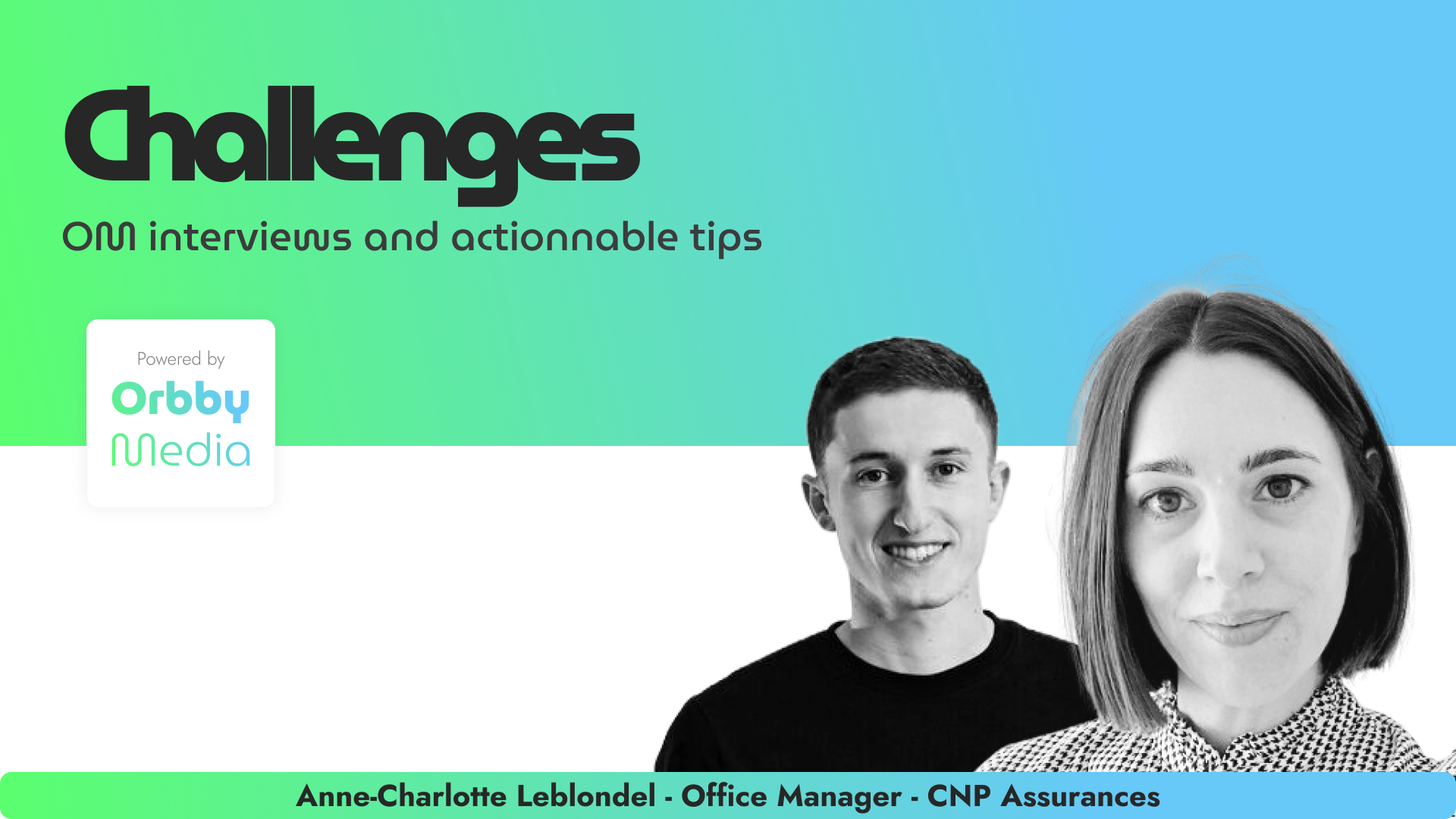
Anne-Charlotte Leblondel, Office Manager at CNP Assurances
January 21, 2026
Moving from communication into office management without losing the thread: that is the path of Anne-Charlotte Leblondel, an Office Manager with a 360-degree view of team and process challenges. Her passed experience at CNP Assurances gave her the ideal ground to connect coordination, internal communication, and employee well-being.
In this interview, she explains how event and communication roles led her to a more transversal position, why she prioritizes being on-site, and how small, thoughtful actions can shift a team dynamic.
Anne-Charlotte’s 3 key tips
- Take onboarding seriously : a simple, human welcome builds trust and engagement from day one.
- Keep team cohesion alive : recurring rituals and micro-events nurture connection, even in a flex office.
- Structure without overcomplicating : clear processes and lightweight tools are enough to gain time and clarity.
The quote to remember
“The Office Manager role is also about creating connection and team cohesion.”
Interview summary
Anne-Charlotte traces a career shaped by event management and communication, which naturally led her to office management. This journey gave her a 360-degree view of a leadership team’s needs: coordination, internal communication, HR support, and process design.
She highlights the value of being on-site for a relationship-driven role, and the importance of concrete actions to reinforce welcome and cohesion. Welcome cards, small rituals, and team moments become levers for well-being at work.
Finally, she shares a pragmatic view of tools: use what saves time, like Copilot to structure meeting notes, without chasing technology for its own sake.
Transcript
Benjamin Albertelli : Can you walk us through your path from your studies to your Office Manager role?
Anne-Charlotte Leblondel : After a master’s degree in tourism, I oriented my internships toward event management. I started in agencies in Paris, with very operational missions: organizing conferences, managing logistics, coordinating participants. What I loved was already the versatility and the attention to detail that makes an event run smoothly.
Quite quickly, my missions integrated communication. I moved from a purely event role to broader positions with internal and external communication. That is what drew me to communication roles, because they were wider in scope and richer in learning. My longest experience was in a new paiement technologies company in Paris, for about seven years, with a very broad range of tasks.
Benjamin Albertelli : You worked through several fixed-term contracts. Was that a choice or the reality of the market?
Anne-Charlotte Leblondel : It wasn’t a deliberate choice. It was the reality of the market. I did temp work and fixed-term contracts, and I worked for many different companies. Each time, I took the opportunities that came up. Some missions were more interesting than others, but they all brought experience.
Looking back, that diversity made me more adaptable. Each mission gave me a skill or a reflex. And it is precisely because I had that base that I was able to access more transversal roles later, like in communication and, eventually, in office management.
Benjamin Albertelli : You also spent a year in Spain. What did that break bring you?
Anne-Charlotte Leblondel : I left for Spain just after my studies, with the desire to speak Spanish every day. I stayed a little over a year in Madrid. I did small jobs: waitress, door-to-door book sales, and especially travel agent after a short training program there.
That experience taught me autonomy and adaptation. I was alone, in another language, with very different missions. Today my Spanish is not as fluent as it was then, but as soon as I go back, the reflexes return. Madrid remains a city I love, even if I do not see myself living there long-term.
Benjamin Albertelli : You eventually returned to Angers. Why that decision?
Anne-Charlotte Leblondel : I am originally from Angers. After several years in the Paris region, with the pace of transportation and city life, I wanted to be closer to my family and friends. I chose to return to the region to build the next stage of my career.
That is how I joined ESSCA on a fixed-term contract, replacing a maternity leave in internal communication. It helped me re-anchor locally while keeping a foot in communication and project coordination.
Benjamin Albertelli : How did the shift from executive assistance to office management happen at CNP Assurances?
Anne-Charlotte Leblondel : I was first hired as an executive assistant in the Amétis service in Angers, mainly composed of customer relations officers. It was a classic assistant role: agenda management, meeting organization, information distribution, administrative support. At that time, I did not see myself as an Office Manager yet. But I tried to add my own personal touch, such as energising their Teams team, Viva Engage, launching an interactive advent calendar at Christmas…
During my second fixed-term contract, the context was different. The service had no assistant before, and the needs went far beyond individual support. My missions took on a more collective dimension: cross-team coordination, interface between teams, HR support, internal communication and I was hired primarily as operational support for the transition to flex office. That is when the position was reclassified as office management, because the reality of the role was larger than traditional assistance.
Benjamin Albertelli : From your perspective, what is the difference between executive assistance and office management?
Anne-Charlotte Leblondel : Executive assistance is often attached to one person, a manager. The Office Manager is attached to a collective. There is a role of connection, a role of cohesion and service toward multiple collaborators. You do not work for one person, but for a direction, a service, sometimes a whole site.
In my experience, that means being both operational support, an information relay, and a guardian of team dynamics. The relational dimension is much stronger. That is what I loved, because I felt useful day to day, beyond an individual scope.
Benjamin Albertelli : What do you enjoy most, and least, in the role?
Anne-Charlotte Leblondel : What I enjoy most is everything related to HR support and onboarding. Welcoming a new colleague, helping them integrate, making their arrival smooth, that is something I love. I also like setting up actions that create connection and energize the team.
What I enjoy less is the very administrative part: purchase requests, invoice follow-up, repetitive tasks. I do it, of course, but it is not the part that energizes me the most. What interests me is the human side and organization in service of the collective.
Benjamin Albertelli : You implemented concrete actions for cohesion. Can you give examples?
Anne-Charlotte Leblondel : Yes, I started with simple things. For onboarding, I prepared a small welcome card with a note from each colleague, sometimes a chocolate or a small attention on the desk. It is a detail, but it changes the perception of the arrival and gives an immediate sense of welcome.
Then I created small animations to feed team spirit: an Easter egg hunt, a compliment board where everyone could leave a kind note, team picnics where everyone brought a dish. These are simple moments, but they strengthen cohesion and help build connections, especially when teams are no longer sitting in the same spot.
I have always had the support of my managers, who were very receptive to my ideas.
Benjamin Albertelli : You were working in a flex office. How was that experienced?
Anne-Charlotte Leblondel : The move to flex office was a large-scale company project, not a local initiative. All services on the Angers site moved into open space and flex office. It involved major renovations and reconfiguration of the building.
The change was difficult at first. Many colleagues had 15 to 20 years of tenure, with habits deeply anchored. Losing a fixed desk, familiar markers, personal objects, it is destabilizing. My role was to support that transition, with communication, listening, and actions to rebuild a dynamic. In the end, acceptance improved, especially because the new spaces were more modern and functional.
Benjamin Albertelli : You say being on-site is important for you. Why?
Anne-Charlotte Leblondel : Because the relationship changes everything. When I am on-site, colleagues come to me more easily. I hear conversations, I notice needs that would not be expressed remotely. It allows me to anticipate and solve issues faster.
I understand that some people need remote days to move forward on deeper tasks. I organize differently: if I need focus time, I isolate myself on-site. But I want to stay close to the team, because that is the heart of the role for me.
Benjamin Albertelli : Would you be open to more finance or accounting tasks in a small structure?
Anne-Charlotte Leblondel : I am open to learning. I already did budget follow-up and I liaised with the finance partner for my service. I do not have a strong base in pure accounting, so I would not take on highly technical topics without training.
However, preparation tasks, information collection, or tracking commitments are not an issue. I have always been comfortable with tools, and I adapt quickly. If a company has an external accountant, I can definitely be the internal relay.
Benjamin Albertelli : Did you consider freelancing at any point?
Anne-Charlotte Leblondel : Not really. For me, office management is an anchoring role within a team. I need to be on-site and part of daily life, building relationships. The on-site presence is essential for the role to make sense.
Working for several companies as a freelancer, with less regular contact, does not match my vision of the job. I prefer to invest in one structure, be the person who knows the needs, habits, and internal culture.
Benjamin Albertelli : In terms of tools, what really helped you day to day?
Anne-Charlotte Leblondel : A simple but very effective tool is the availability poll integrated in Outlook. When I need to gather many people, it shows the best possible slots without spending hours analyzing everyone’s calendars.
We also used Teams and internal tools. But the tool that saved me the most time recently is Copilot. I used it to structure meeting minutes: I took raw notes in meetings, ran them through Copilot, then reworked the structure. It helped me clarify, format, and move faster.
Benjamin Albertelli : And for emails?
Anne-Charlotte Leblondel : The same, I sometimes used it to rephrase. When I was not satisfied with a wording, I asked for a clearer or more punchy version. It helped me gain impact, while keeping control of the final message.
AI mainly helped me with rephrasing and idea structuring. I did not use it for technical tasks like Excel. My use was focused, to save time and improve readability.
Benjamin Albertelli : What are you looking for next?
Anne-Charlotte Leblondel : I want to return to an Office Manager role, ideally within a leadership team like at CNP Assurances, or in a smaller structure that needs a highly versatile person. What matters to me is being at the center of the collective and playing that connection role.
The market in Angers is more limited and the term “Office Manager” is still not widely used. There are mostly traditional assistant roles, so I also send spontaneous applications. I remain motivated, because I know what I can bring: organization, cohesion, and a real sense of service.
Benjamin Albertelli : A final word to close?
Anne-Charlotte Leblondel : I hope my role was well understood, because it is not just about assisting, but about helping the team work better together. That is what I tried to do in every mission, and it is what I want to continue doing.