
Orbby Media
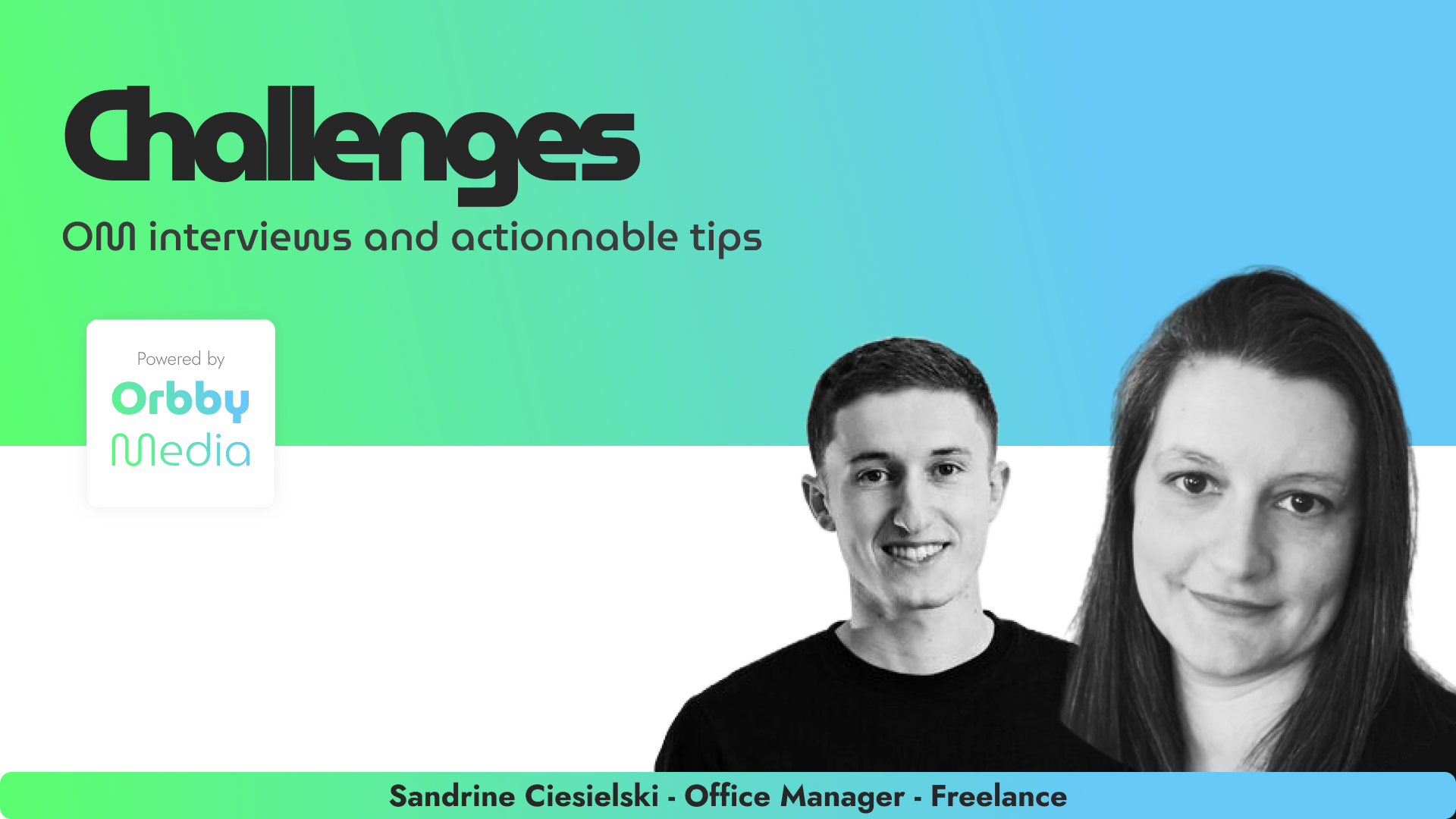
Orbby Media banner: Challenges, interviews and actionable tips

Sandrine Ciesielski, Freelance Office Manager

January 28, 2026

Sandrine Ciesielski is a freelance Office Manager based in northern France. With over ten years of experience across assistance, HR and general services, she chose independence to support TPE/SME leaders and bring order to growing operations.

In this conversation, Sandrine explains how she built processes from scratch, how she learned to prospect despite her reluctance, and why the human link remains at the heart of her work.

Sandrine’s 3 key tips

  • Structure before accelerating: simple, clear processes reduce emergencies and secure daily operations.
  • Show up even when it’s uncomfortable: posting, pitching and initiating contact creates opportunities.
  • Lean on your network and tools: collectives, mentoring and tools like Notion make progress more sustainable.

The key quote from the interview

« As long as I’ve done what I had to do, it isn’t a failure. »

— Sandrine Ciesielski

Interview summary

Sandrine looks back on a career built through assistance roles, training environments and cross‑functional responsibilities. She gradually expanded her scope until stepping into an Office Manager role where everything had to be structured, from HR processes to general services.

She then shares the shift to freelancing: a choice driven by autonomy but also the need to sell yourself, to prospect, and to find the right market positioning. She highlights LinkedIn visibility and pitch work as essential levers.

Finally, she emphasizes the importance of a strong framework: coaching, a freelance collective, tools like Notion, and above all a human and reliable approach to supporting leaders day to day.


Transcript

Benjamin Albertelli: Can you walk us through your journey from school to becoming a freelance Office Manager?

Sandrine Ciesielski: I didn’t start in office management right away. It came step by step. I began in administrative support roles—switchboard, back‑office tasks, helping sales teams. That kind of environment teaches you to adapt fast because you deal with urgencies, last‑minute requests, and constant adjustments.

Over time, I moved toward more structured assistant roles. I worked in a training center, then in companies where versatility was essential. What I enjoyed most was having a global view, not just completing isolated tasks. I like understanding the whole system and making it run more smoothly.


Benjamin Albertelli: You also pursued training while working. Why was that important?

Sandrine Ciesielski: At some point, I felt I was going in circles. I wanted to go further, so I enrolled in a management and organizational degree at CNAM while working. It was intense—work during the day, classes at night, assignments, Saturdays too.

But it broadened my skills. I wanted to understand organizations beyond the purely administrative layer. That degree gave me a different lens on processes, responsibilities and how companies are structured.


Benjamin Albertelli: You spent several years in training, then shifted sectors.

Sandrine Ciesielski: Yes, I spent five years in a training center, mostly on administrative and financial tasks. I handled pre‑accounting, invoices, and file management. It was solid experience, but I eventually needed a new challenge.

Then I joined a company where I truly discovered office management in its full sense. Nothing was in place. There were no HR processes, no clear invoice tracking, no reporting. Holidays were tracked in separate Excel files, requests were made verbally, and nothing was formalized.


Benjamin Albertelli: That’s when you entered a startup‑style environment?

Sandrine Ciesielski: Exactly. The company was building itself, and I clicked with the founder. I joined a situation where everything had to be created. My onboarding was basically: “Hi, I’m David, here’s your desk.” I had a notebook and a pen—no laptop yet (the delivery guy had an issue). It was funny, but very telling of the challenges ahead.

So I had to set the foundations: create simple rules, put written requests in place, organize leave, structure purchases, and find the right providers. That’s where I fully stepped into the Office Manager role: building a framework where there wasn’t one.


Benjamin Albertelli: Did you feel a big difference from classic assistant roles?

Sandrine Ciesielski: Yes, clearly. In assistant roles, there are already routines. In this job, everything was to be invented. We started with six people and grew to forty, across two sites, plus temporary staff and external providers. The scale was different.

I was handling general services, pre‑accounting, parts of HR, and internal communication. At one point I was on all fronts and couldn’t do it all. We reviewed my scope, and I decided to drop accounting so I could keep what I loved most: the human side and everyday team support.


Benjamin Albertelli: You stayed several years. Why did you leave?

Sandrine Ciesielski: The company grew, needs evolved, and specialized roles were created. An HR manager joined to structure more technical policies, which was necessary.

On my side, I felt that the company’s direction no longer fully matched my own. We parted on good terms. I had done four strong years, and I was ready for a new chapter.


Benjamin Albertelli: And that new chapter was freelancing.

Sandrine Ciesielski: Yes. There was a short pause because my husband and I moved and became homeowners. And I had already done a coaching program with Chloé (liste the podcast with Chloé) that helped me clarify my project. The idea of freelancing had been in my head for years, but I didn’t dare.

The turning point was: “Why not now?” I wanted to use my experience to help leaders regain control of their organization. Today I position myself as a freelance Office Manager & Assistant, with a very methodical and human approach.


Benjamin Albertelli: How has it been over the last few months?

Sandrine Ciesielski: There have been good opportunities, but not always conversions. It’s an emotional rollercoaster: when someone contacts you, you’re motivated, and then sometimes it doesn’t materialize. I think that’s normal when you start.

I had to learn new ways of finding clients. The market changed; you don’t look for work the same way as 10 or 20 years ago. I leaned into LinkedIn and started structuring my prospecting.


Benjamin Albertelli: You mentioned that cold calling is hard for you.

Sandrine Ciesielski: It’s very hard. I don’t like calling people “cold.” It’s almost pathological. If I’ve already exchanged on LinkedIn, or have a recommendation, I’m fine. But calling a number found on Google—no, I can’t.

That’s why I’m working with the BGE, an entrepreneurship support group. They help me structure outreach: company research, first contact by email, then follow‑ups. It’s more gradual and more reassuring for me.


Benjamin Albertelli: You’re also posting more now. Is that a shift?

Sandrine Ciesielski: Yes. As an employee, I shared articles and experiences, but I didn’t have to “sell myself.” Now I do. I have to speak about what I do.

At first it was uncomfortable. I saw people promoting themselves and thought: “They’re brave.” Then one day I realized I could do it too. The connection happened, and I told myself: “Ok, it’s my turn.”


Benjamin Albertelli: Any strong memory about pitching?

Sandrine Ciesielski: At a BNI meeting, I expected 1 minute 30 to introduce myself, and they told me: “You have 45 seconds.” I panicked, but I went for it. I stumbled at first, then someone made a joke that relaxed the room, I laughed and finished.

Afterwards people said: “You looked comfortable.” That surprised me because I didn’t feel comfortable. But it showed me I could do it. I realized the impostor syndrome had held me back for years, and that I could move past it.


Benjamin Albertelli: What helps you push through those blocks?

Sandrine Ciesielski: Personal work, training, and a real shift in mindset. I realized I had often worn a mask to match expectations. Today I tell myself: “As long as I’ve done what I had to do, it isn’t a failure.”

If I stay in my corner waiting for things to happen, that’s failure. So I take action, I search, I try. And I know it will work.


Benjamin Albertelli: You joined a collective, Office lab. What does it bring you?

Sandrine Ciesielski: First, a space to exchange with other back‑office professionals. Unlike networks that focus only on Office Managers, this one includes accounting, HR, IT and more. That diversity is valuable.

There’s also a referral system, which can help when business is slow. But beyond that, it reduces isolation. Freelancing can be lonely, and having a community makes a big difference.


Benjamin Albertelli: How do you handle daily freelance life?

Sandrine Ciesielski: It’s a challenge. You’re at home, you have to self‑motivate, structure your days, and avoid doing household tasks instead of work. It takes discipline.

I’m also lucky: my husband supports me a lot. He told me: “You’ve sacrificed for my projects, now it’s your turn.” That gave me momentum. He also makes sure I take breaks and don’t overdo it. That support is precious.


Benjamin Albertelli: What tools help you most?

Sandrine Ciesielski: Notion, without hesitation. I didn’t use it in companies because I didn’t have time to learn how it works. Freelancing is what allowed me to use it today. It’s my CRM, my project management space, my personal wiki. I also use Notion Calendar for scheduling.

I also use AI in general for my posts. I write a draft, then refine it to make the message more impactful. It helps with reformulation and saves time while keeping my own voice. I can use ChatrGPT, Claude and Perplexity depending on the need.


Benjamin Albertelli: To wrap up, what are you looking for now?

Sandrine Ciesielski: I want to support leaders who need a real operational relay. My role is to structure, streamline, and relieve. I bring stability, processes, and a human connection.

I know it’s coming. The next step is signing my first client, and I’m convinced it will happen. I’m moving forward, step by step.